Blog

Chapter 5- Gum Disease [periodontal disease]

What is gum disease?

Gum disease [periodontal disease] is disease within the supporting structures [gingiva, periodontal ligament, alveolar bone] that hold your teeth in your head [see basic anatomy].

It is the most common chronic inflammatory disease seen in humans.

In its severe form it is the 6th most common disease [people aged 15-99] in the world, affecting 10.8% of the world’s population some 743 million people [Global Burden of Disease Study 2010].

In the UK it affects approximately 45% of people with teeth [dentate] over 16yrs, with 37% mild, 7% moderate and 1% severe levels of disease [Adult Dental Health Survey 2009].

It is caused by accumulation of plaque due to inadequate oral hygiene. This starts it off and is responsible for its continuation.

It is often referred to as a ‘silent disease’ as to start with the patient is often completely unaware there is a problem and it isn’t until the disease is well established that the patient has symptoms that may prompt them to seek help.

In early stages of the disease the patient may experience bleeding of their gums, receding gums and bad breath [hopefully pointed out by a concerned friend or partner].

Eventually this progresses to loss of tissues that hold your teeth in your head [periodontium], tooth mobility, drifting and finally tooth loss.

In it’s early stages periodontal disease is a common preventable disease that can be treated a relatively low cost.

Like all diseases the earlier it is detected the greater the chance of successful treatment and the better the outcome for the patient.

Prevention is better, simpler, cheaper and less painful than cure!

Leaving aside one or two more specific gum conditions this section is all about ordinary ‘common or garden’ general gum disease which we can all get.

Gum disease or periodontal disease encompasses two conditions Gingivitis and Periodontitis.

Gingivitis.

In health your gums should be pink, stippled [a bit like orange peel], with a knife edge point of gum between your teeth [colour may vary due to ethnicity].

Think of your gum as a little windowsill around your tooth, plaque sits on this little window sill, bits of food debris stick to the plaque and little colony of bacterial plaque feed on these bits of food debris producing toxins as a by-product and they of course, multiply. The gum [gingiva] is a little collar around your tooth like a short tight polo neck [see basic anatomy]. The toxins make this little collar of gum irritated and inflamed and so it swells. So your little polo neck turns into a deeper polo neck and eventually into a floppy turtle neck.

The plaque on your teeth is the same bacterial plaque that causes caries [tooth decay] but no sugar is needed to cause gum disease.  It is an NCD [non communicable disease], you don’t catch it from other people. The bacteria which cause it are endogenous, they live on you anyway. Which bacteria? Hundreds of different types and they are the ones we know about!

‘itis’ means inflammation as in tonsillitis, appendicitis etc. Thus Gingivitis is inflammation in the gingiva.

Behind your little collar of gum is a little gutter between the polo neck and your tooth, so an indication of how bad this infection is can be found by measuring the depth of the gutter, officially called a periodontal pocket.

Your dentist will do this with a special probe with marks on it called a periodontal probe. This probe also has a bobble on the end, so it only measures what’s there, it doesn’t make a hole!

In health this measurement should be 3mm and under [though I aim for all of my patients to have pockets under 2mm]. If your gums are inflamed and swollen this measurement will be bigger, this is called false pocketing. They will also bleed.

As the bacteria in the bottom of this pocket accumulate you start to get colonisation by more specialised bacteria that are able to survive without oxygen [anaerobic]. Inorganic ions in your saliva become incorporated into the plaque and the plaque hardens into calculus [tarter]. A bit like the fur in the bottom of your kettle.

This situation can be reversed by good oral hygiene. However while you can get on with the good oral hygiene you will also need to have a professional cleaning by a dentist, hygienist or therapist. Why? Because if you have a lot of calculus stuck on your teeth and in the little gutter around your teeth you will never with the best will in the world be able to get it off yourself and get your gums back to complete health. They will never be happy and healthy lying over bumpy calculus. A bit like trying to iron your shirt on a bumpy ironing board!

At this point this condition is reversible by hard work on your part and, with the help of your dental team, teaching yourself to clean your teeth effectively and efficiently. More to the point continuing to do so for ever!

You don’t have to clean all of your teeth- just the ones you want to keep!

Remember this little mantra- If they bleed they are sick, you need to clean them better!

Periodontitis.

If gingivitis is not treated by you with the help of your dental team, toxins produced by the bacteria build up in the bottom of the pocket and eventually begin soaking into the tissues through tiny micro ulcers [ulcer is a descriptive term meaning ‘a hole in your skin’].

From here they gradually destroy the little ligaments that hold your tooth in its bony socket and the pocket around your tooth deepens into what’s called a true periodontal pocket. This carries on going, creating deeper and deeper pockets allowing more plaque to collect and calculus to develop in the bottom of the pockets. Eventually the bone around your teeth is destroyed, your tooth becomes loose and is lost.

Thus periodontitis is a continuation of gingivitis.

Other Factors.

Now while periodontal disease is a bacterial plaque led disease there are other factors involved.

The factors involved in gum disease are;-

Genetics [for which you can cheerfully blame your parents], poor oral hygiene, smoking, undiagnosed or poorly managed diabetes and no doubt others we have yet to discover.

Do you know what genes you’ve got? Well I don’t and I’m too scared to risk it!

So if you have the wrong genes and you exacerbate that by poor oral hygiene and smoking you are stuffed as far as keeping your teeth is concerned!

A word here about smoking, apart from the fact that you know it’s a bad thing one of the problems for smokers is because the blood supply to their gums is reduced they don’t necessarily get bleeding and so they don’t pick up early signs of gum disease.

Where do you start?

Well as with any disease you need to start with discovering it, diagnosing it correctly, deciding if it’s limited to a few teeth in your mouth or all of them [localised or generalised], deciding how bad it is and forming a plan of action.

You can start by cleaning your teeth properly as well as you can.

Then you need to go to the dentist. One of the problems with gum disease is patients often don’t visit the dentist until they have a problem. With gum disease they might get bleeding, bad breath, a horrible taste in their mouth from pus or gasses given off by the bacteria, their teeth might be loose, moving around or painful. By this time things are well on their way.

The best way to deal with any disease is to stop it happening in the first place.

Prevention is better, simpler, cheaper and less painful than cure!

The time to go to the dentist is before you have problems, in fact before you have the disease in the first place. Your gum disease status should be checked every time you go for a check-up from when you are young so early indicators can be picked up, advice given, oral hygiene techniques taught and you are in good habits to prevent you getting gum disease in the first place.

BUT IT’S NEVER TOO LATE- GO NOW!

What will the dentist do?

Well they will do all of these things;- check your medical history, take a history of whatever is bothering you [a history as you say in medicine is the story in the patients words, what the problem is how long you’ve had it what makes it better/ worse etc], then they will probably ask you a whole load of questions about your problem and various other things such as your oral hygiene regime, check all of your teeth and restorations, look over your mouth and surrounding areas for any signs of oral cancer or any other conditions, MEASURE THE POCKETS AROUND YOUR TEETH WITH A PERIODONTAL PROBE, chart all these findings.

They may do various other ‘special tests’ which will probably include taking xrays [radiographs] if they do not have recent ones to refer to.

Then they will get it all together in their head and explain it all to you. I find visual aids very helpful for this, I draw little diagrams or use flip charts, some people may use little videos, all sorts. The dental team’s job is to explain to you, hopefully in a way that you will understand the overall condition of your mouth, all of it, holistically in keeping with the rest of your body. Then identify any problems they feel you have, explain what hopefully the solution is and what they would advise as a plan of action [this is called a care plan]. Let the dentist talk you through it in what they feel is a logical order. Most of us have a well rehearsed script which has all the information in it we feel is important. It’s very easy to get lost if the patient keeps interrupting all the time, listen first, then ask the questions. I usually stop every so often and ask the patient if they want me to repeat anything, I am sure your dentist will do the same, it’s no good charging ahead if the patient has got lost along the way.

 Several things to say-

Answer all the questions as well as you can, if you can’t remember a sequence of events write it down.If you don’t tell them they won’t know!

If you are on any tablets or medicines and you can’t remember the names take a list or a copy of your latest prescription. If you have had a lot of operations or other complicated medical things write it down with approximate dates.

If you are worried, apprehensive, scared stiff, panicky, anything- say so. While experienced dentists are pretty good at reading body language even the most experienced of us get it wrong sometimes. Nobody minds, we’ve heard it all before, everybody is different, we all have things that upset us and worry us or we are scared off, don’t feel you have to pretend. I’ve had great big blokes cry all over me- I don’t think any the worse of them- it’s fine. IT WILL BE FINE. It’s a lot easier from my point of view to deal with someone if I know what worries them, your dentist has many skills but I doubt if telepathy is one of them. You can’t help a patient get over/ cope with their worries or fears if they don’t tell you what they are.

If you need to take someone for moral support- do so. No one minds.

If you don’t understand what the dentist is telling you, get them to say it again. All of us however intelligent we are when faced with something new, out of our field, unusual etc get confused. Get them to repeat it till you do understand it. Their role is to teach you how to look after your teeth and that starts with you, the patient understanding the problem. You’re not daft, it’s just new to you that’s all. Some treatments might have options, that will be explained to you and if you’re not sure- ask.

The dentist will give you an honest appraisal of the condition of your mouth and supporting structures [like a surveyor when you’re buying a house], they will advise you as to what they think a suitable care plan should be. When it has all been explained and you have asked any questions you might have, it’s up to you to think about it all and decide what you want to do. You are the patient, it’s your mouth. You have to decide, patients quite often ask me what I would do in the same circumstances and I always tell them but it’s still up to the individual to decide for themselves.

The dentists job is to look at the whole of your mouth and surrounding area as part of the rest of your body. The dentists job is not drilling holes in teeth! They will look at everything including what ever you feel is your problem which may not be what the dentist identifys as being your most important problem. The point of the care plan is to treat things in a logical order. That logical order starts with you being able to maintain your dentition properly with good oral hygiene and making sure your teeth are solidly in your head by tackling any gum disease issues first. As every builder knows the most important thing about a well built house is solid foundations, spend what you like on designer wallpaper but if your house is going to fall down there is no point!

But life gets in the way sometimes- diagnosis, plan of action, then what? The patient understands, they know what they need to do themselves and in terms of treatment. Then something happens- they are ill, they have a baby, their Mum dies, they lose their job, move house, split up with a partner just can’t hack it for some reason at the moment. Not in the right mind set. That’s OK we understand. As long as you understand we can’t change the rules of science, can’t change the diagnosis, the bugs don’t know what’s going on in your life and what’s more they don’t care either!  But we do and we understand and one day when you feel better we will be there for you.

Further reading.

Don’t take my word for it, look up the British Society of Periodontology at www.bsperio.org.uk

Periodontology is the science of Gum Disease. It is a specialist subject within Dentistry. The society is ‘devoted to education and raising awareness within the dental and medical professions, students, patients and the general public of the importance of gum health for all ages’. Anyone can look up its resources and read the information. It has a very good patients section and you can down load and print things off including better info graphics than mine!

Diagrams.

Here few diagrams, I hope they are understandable gum disease is much easier to understand visually. I hope they are helpful.
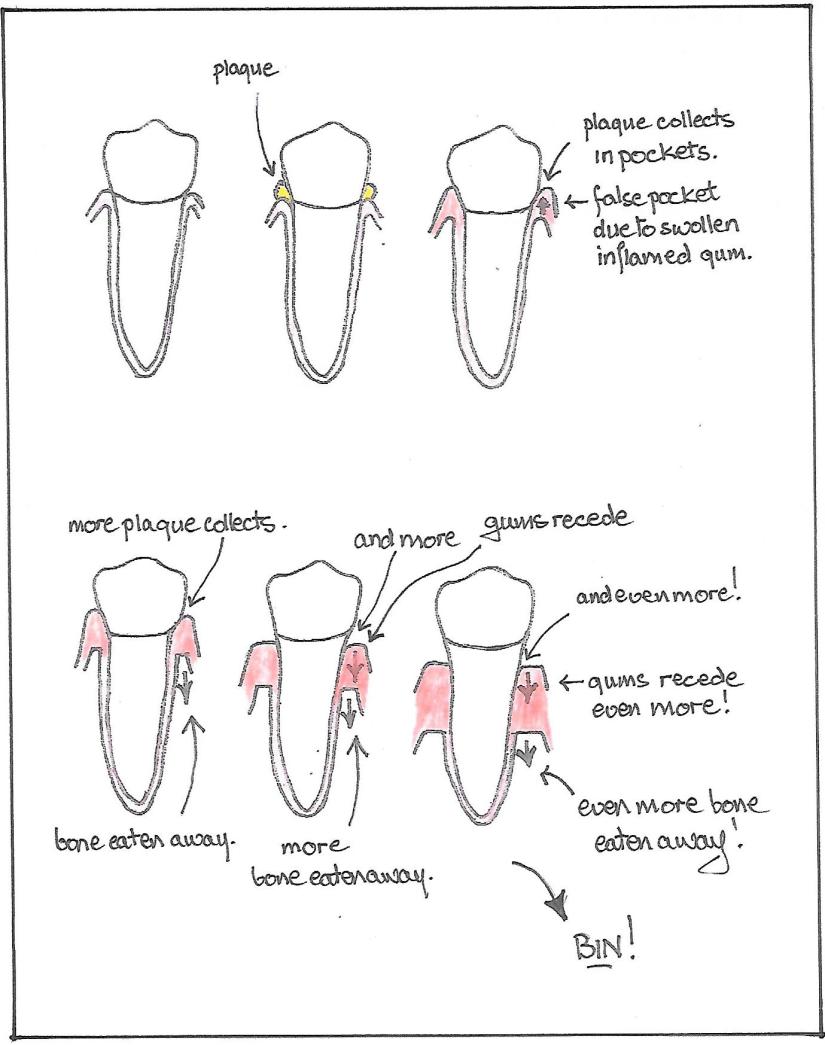
Perio pic

Chapter 4- Fluoride

History.

In the later part of the 1800s a dentist named  Fredrick McKay practicing in Colorado Springs in the USA noticed that his patients had very mottled teeth but at the same time fewer cavities than usual. He and no doubt other dentists in the area began to suspect that it was something in the water. The stain was known as Colorado brown stain [present for life].

In 1918 McKay published the first article on the subject theorising that it was the presence of fluoride in the water that caused the mottling.

Since those days there have been hundreds of studies all over the world in different types of populations looking at tooth decay [caries] and it’s relationship with the amount of fluoride in drinking water. Chemical and statistical analysis methods gradually improved over time and in the 1930’s the optimum level of fluoride content in drinking water was determined. A level with maximum reduction in tooth decay for no or minimum mottling [fluorosis]. This is 1ppm [part per million].[ Research lead by a US dental officer and epidemiologist with the wonderful name of H.Trendley Dean]

In 1964 Birmingham City Council decided to fluoridate it’s water supply. This led to a dramatic drop in caries in children in that area.  Today 5 year olds in Birmingham have approx. 34% fewer decayed teeth and 2 year olds 42% decayed teeth than children of the same age in Manchester without fluoride.

There is fluoride in all tap water but it varies with the rainfall and where your water supply comes from so it may not be to the therapeutic level of 1ppm.

10% of the population of England receive drinking water with the optimum level of fluoride! USA 70%, Ireland 70%, Hong Kong and Singapore 100%, Australia 89%.

The WHO considers water fluoridation to be a safe and effective public health measure. Water fluoridation is supported by Public Health England, The British Dental Association, The British Association for the Study of Community Dentistry and The British Medical Association among others. It has cross party political support.

Badly decayed teeth in children leads to pain, abscesses and ultimately extraction. Extraction of badly decayed teeth is the commonest reason for young children to have a general anaesthetic in the UK.

Water fluoridation reaches everyone in the community, as a public health measure it is very cost effective. None of us, the public have to do anything.

Don’t take my word for it- look it up yourself. The British Society of Paediatric Dentistry has a position statement on the subject. www.bspd.org

Fluoride in toothpaste.

Now up until the ‘80s it was thought that fluoride produced its effect by being incorporated into tooth enamel as it is formed. That meant it had to be ingested from fluoridated water intake or various other mechanisms that have been tried- tablets, fluoridated salt and fluoridated milk.

We now know that this is not the case.

Over the years research has shown that fluoride produces its effects in a number of ways which combine to slow down and prevent caries.

We now know that it is the fluoride in toothpaste [introduced in the 1970s] left in the mouth incorporated into the oral fluids and taken up by plaque on the teeth that interferes with the demineralisation process of enamel caused by acids [a by-product of the bacteria in plaque metabolising sugar in the diet].

Teeth and bone are composed of a crystalline mineral compound of calcium and phosphate called hydroxyapatite. Carbonated liquids weaken this structure and make it susceptible to acid attack.

Plaque on teeth is composed of food debris, saliva and bacteria all mixed together to produce a slimy paste. These bacteria metabolise sugar in the diet and produce acid. This lowers the pH in the mouth and on the tooth surface underneath the plaque to below the normal pH of the mouth. When this gets to below 5.5 tooth enamel starts to demineralise [this is called the critical pH] losing its calcium and phosphorus ions into the plaque and saliva. When the pH climbs back up to 7 [neutral] this reverses, the ions flow back and the tooth enamel remineralises. If when this is happening fluoride is present it gets incorporated into the hydroxyapatite on the tooth’s surface to form fluorapertite which is more stable and resistant to acid attacks. The pH has to be much lower at 3.5 for fluorapertite to demineralise. The way fluoride works is microscopically and chemically much more complicated than this and subject to ongoing research but I think this will do for now.

All you have to know is that fluoride is A GOOD THING and essential in reducing/ stopping caries. It is at its best applied topically in toothpaste/ varnishes. You need a constant application as in tooth brushing twice a day.

It is not a magic bullet on its own, for caries to be avoided you need;-

Good oral hygiene twice a day, reduction in the amount and frequency of sugar consumption, fluoride.

Two minutes, twice a day, spit don’t rinse.

Too much fluoride.

As with anything beneficial too much is a bad thing, too much fluoride causes fluorosis in developing teeth. An enormous amount would be poisonous.

This is why the amount of toothpaste and the concentration has to be carefully monitored for children.

Don’t leave toothpaste around where small children can get hold of it and eat it out of the tube, even more attractive if it has a sweet fruity flavor!

If someone in the family has been prescribed higher dose fluoride toothpaste by their dentist for added protection for some reason be especially careful not to leave it lying around. This type of tooth paste is a POM [prescription only medicine] and only for the person it was prescribed for.

Make sure you use the right amount and the right dose of fluoride for every age group.

Under 3yrs– a small smear of toothpaste with at least 1,000ppm, twice a day supervised brushing, spit don’t rinse.

3-7yrs– a pea sized amount of toothpaste with more than 1,000ppm, twice a day supervised brushing, spit don’t rinse.

7yrs and upwards- a toothpaste with 1,300- 1,500 ppm, twice a day, spit don’t rinse.

Overdose.

If you think your child might have been eating the toothpaste out of the tube-

A little bit get them to drink a large volume of milk this will neutralise it.

If a 1 year old has eaten 1/3rd of a 100ml tube of adult toothpaste this would be poisonous. For a 5 year old 2/3rds of a tube. If any doubt HOSPITAL STRAIGHT AWAY.

Chapter 3- Tooth surface loss not caused by decay.

There are 3 types of wear on teeth- Erosion, Abrasion and Attrition.

There is another called Abfraction but that’s a bit more esoteric so we won’t worry about that for now.

Erosion.

pH is a measure of acidity from 1-14 [remember your chemistry lessons].

Big numbers alkali, little numbers acid. pH 7 neutral in the middle.

Anything with a pH of less than 5.5 will dissolve the enamel off your teeth.

These things are- fruit juice, fizzy drinks, citrus fruits consumed in large quantities, wine [sadly], smoothies, yogurt, vinegar, salad dressing and vomit if you are sick a lot.

Saliva has a buffering action, it will buffer it back to neutral, but it takes 40 minutes to an hour to do so.

When you drink a glass of fruit juice say, it softens the outside layer of your enamel. If you brush your teeth straight away, you will brush off that soft layer. It may only be microscopic, but after 20 years it adds up to a lot of enamel. Once it’s gone, it’s gone forever- never to return!

So if you eat or drink anything acidic you need to leave at least an hour before you brush your teeth. To allow your saliva to neutralise the acid and for your enamel to re harden.

Much easier not to have anything acidic for breakfast as you need to wait an hour before you brush your teeth, or brush them before breakfast or when you get to the office.

Sipping from cans.

If you drink a can of drink straight from the can, all of the acid in that can [diet or otherwise, may have fewer calories but it is just as acidic] goes straight out of the ring pull hole onto your 2 front teeth. You will see people sometimes with a big ‘sippers V’ triangular notch dissolved out from between their two front teeth.

When you take a sip, the pH in your mouth drops and your mouth becomes more acidic. Your saliva starts to neutralise it, 5 mins later you take another sip, your pH drops again, your saliva starts to neutralise it. If it takes an hour for you to drink that can of drink that means your teeth have been bathed in acid for an hour and then a further hour, gradually increasing in pH while your saliva neutralises the acid.

Don’t drink straight from a can, put it in a glass, drink from a wide bore straw, don’t swish it around your mouth and better still- don’t drink it at all!

If you are thirsty, drink water. All other drinks should be an occasional treat, not used to quench your thirst. Drink 8 glasses of water a day to stay healthy- to cool you down when you are hot, to give you enough circulating blood volume, to make enough saliva to lubricate your mouth, tears to clean your eyes, to make sure the cells in your body are turgid [full], to get rid of toxins in your urine, to make sure food passes through you easily, to stop your skin being dry and 101 other reasons.

Free Sugar.

There are lots of different types of sugar; glucose, sucrose, maltose, lactose, fructose. They all have different cariogenic rates [rot rates]. Sucrose is the worst [refined sugar in cakes, sweets, biscuits etc] . This is because the refining process changes the sugar from natural sugar to ‘free sugar’ which more readily attacks your teeth. Juice which has been pasteurized ie heated up to destroy the bacteria [so it can be transported in a refrigerated ship or lorry from far away, to your supermarket] contains ‘free sugar’ as the process of pasteurizing converts the fructose in the fruit to free sugar.

If you must drink juice- ‘the more bits the better’, make your own, drink it with a meal but not breakfast, drink it through a straw,  wash your mouth out with water afterwards. Better still don’t drink it at all!

Better to eat whole fruit, you need the roughage to reduce your risk of bowel cancer and the fructose in the fruit is locked in the cells not free.

Milk.

Milk has a nearly neutral pH of 6.8, so it helps to reverse the acid attack. It also contains Caesin a protein which forms a protective layer on your teeth this helps with the Calcium and Phosphate metabolism of your enamel.

Medical conditions.

Some people have medical conditions or eating disorders which means they either regurgitate their stomach contents or vomit on a regular basis.

Stomach acid has a pH of 2. It is very acidic and will have the same erosive effect on teeth.

Some conditions are- Bulimia, Reflux oesophagitis, Hiatus hernia, Stomach ulcers and side effects of some chemotherapy drugs. If you have any of the above conditions it is vital that you seek your dentists help to avoid eroding and destroying your teeth.

Abrasion.

Abrasion is scrubbing your teeth from side to side. If you do this you will wear groves in the side of your teeth which weakens them and makes them sensitive. These are called ‘abrasion cavities’. If you do have a tendency to scrub from side to side and you really can’t get out of the habit you may be better with a round headed electric toothbrush. You don’t need to do the round and round bit it does it all for you! [see no 6].  If you have really big groves speak to your dentist about having adhesive restorations placed [no drilling] to strengthen your teeth and stop sensitivity. Or you may just need a desensitising toothpaste if they are not too deep, read the back of the box to make sure it contains the right dose of fluoride [1350-1500 ppm] as well as a desensitiser.

I often find that abrasion often occurs in patients who are fastidious cleaners but have never been taught the correct method and so do themselves a lot of damage unwittingly. There is no substitute for professional instruction, it is a sound investment because once you have been taught the correct method and you master it, you are set up for the rest of your life.

Attrition.

Attrition is tooth surface loss on the biting surfaces, usually due to grinding or clenching. If you also soften the enamel with acid erosion the effect will be even worse. Attrition will lead to restoration failure, sensitivity and a host of other problems.

Go and see your dentist you need help!

This is only a quick overview, nonbacterial tooth surface loss is a very complicated subject with many factors and quite often a combination of more than one type. It needs to be properly assessed by a professional.

Go and see your dentist! Timely advice should be sort before it’s too late.

Prevention is better, simpler, cheaper and less painful than cure!

Chapter 2- Sugar -and the evils there of

Sugars are types of soluble carbohydrate that provide energy in our diet.

Compared to other types of carbohydrate they are quickly absorbed into our body and are less filling.

They can be used to enhance the flavour of food and drink which makes them an attractive option for both consumers and the food and drink industry.

Sugars are either intrinsic or extrinsic.

Intrinsic sugars occur naturally within the cellular structure of food as in fruit and veg. Generally intrinsic sugars are not thought to have an adverse effect on general or dental health as the sugar is ’locked in’.

Extrinsic sugars can be ‘natural’ as in honey or lactose [milk sugar] or added to food by either the manufacturer, the cook, or the consumer [you and me].

Leaving aside milk sugar all the other types of extrinsic sugars are known as FREE SUGARS [WHO 2015] and are detrimental to our health and to our teeth!

Food labelling has got much better in recent years but it is still quite difficult to tell how much sugar is in the contents of the packet. Or how much carbohydrate is actually sugar.

As a little guide here are a few clues;-

The nearer the front of the list of ingredients something is, the higher the content.

Some manufacturers use a traffic light system for sugar content. Green is good!

The WHO recommends that free sugars make up no more than 10% of your diet but the new guidelines recommend that if this was reduced to 5% it would have further benefits.

For an adult woman of normal BMI this is 25grms or 6 teaspoons.

For an adult man of normal BMI this is 8 teaspoons.

A lot less for children as they have lower energy requirements.

A standard can of cola contains 8-9 teaspoons!

Consuming too much sugar leads to;-

Overweightness and obesity.

Increased risk of high blood pressure, type 2 diabetes, cardiovascular disease and some cancers.

Dental plaque which causes tooth decay and gum disease.

‘5 a DAY’

Fruit contains intrinsic sugars so they are locked in. As long as you make that 3 veg and 2 fruit and no more than 1 piece of citrus fruit per day so you don’t dissolve your teeth away with acid the health benefits from the roughage, vitamins and minerals outweigh the small amount of acid damage.

Different fruit and veg contain different vitamins and minerals- mix up the colours.

FRUIT JUICE.

Juicing fruit releases the sugar content of the fruit and turns it into free sugar. Frequent exposure to the sugars and acids when fruit is juiced leads to tooth decay and dental erosion.

Smoothies are the same, if you drink them drink the pulp as well, you need the fibre as well as the vitamins and minerals.

Don’t drink either in between meals.

DRIED FRUIT.

Contains super concentrated sugar as all the water content has been removed. It is also very sticky so it stays on your teeth for longer. Don’t use as a between meals snack.

The worst snack you can give a small child is a carton of juice and a little box of raisins!

MILK.

Milk is an important source of calcium and phosphate both of which contribute to the maintenance of healthy teeth. Milk also contains caesin a protein which forms a film on teeth protecting them from loss of calcium and phosphate when exposed to acids.

Milk does contain milk sugar [lactose] but this is considered to be the least cariogenic [cavity forming] of the sugars.

However do not put your baby to bed with a bottle of milk as this prolonged exposure leads to early childhood decay [used to be called bottle caries and rots all of the baby’s front teeth].

Be careful of milk alternatives- some of them contain a lot of sugar, read the label very carefully.

DIET.

A healthy, balanced diet and physical activity is recommended for healthy weight, in particular, a diet high in vegetables, a moderate amount of fruit, complex [unrefined] carbohydrates, protein and low in fat, saturated fat, salt and sugar.

Figures available in NHS digital state that in 2014 62% adults in England were overweight or obese an increase of 9% over 20yrs. 2/3 men and 6/10 women. 1 in 5 kids aged 10-11 were overweight or obese.

28% of children between the ages of 2 and 15 years are now classified as being overweight or obese!

SHOPPING.

Many foods and drinks contain sugars which is not always obvious to the purchaser. These will be listed on the labels as:-

‘glucose’, ‘glucose syrup’, ‘fructose’, ‘concentrated fruit juice’, ‘sucrose’, ‘dextrose’, ‘honey’, ‘inverted sugar’, ‘maltose’, ‘hydrolysed starches’, ‘molasses treacle’, ‘corn syrup’, etc.

Honey is refined sugar it’s just been refined by bees and not Mister’s Tate and Lyle!

These are all sugars and cause tooth decay. The use of the following expressions on food/drink packages does not mean that they are safe for teeth:

No added sugar’, ‘no artificial sweetener’, ‘sugar free’, ‘low sugar’, ‘lite’, etc.

Beware the expressions used on packaging ‘tooth kind’ makes it sound as if the more you drink it, the more good you are doing to your teeth it doesn’t mean this at all, it just means ‘not as bad as all the rest’!

Keep sugar to meal times only. The combination of sugary food and/or drinks, with bacteria in the mouth [plaque] leads to the production of acid which causes tooth decay.

Each time food and/or drinks are consumed that contain sugar, the plaque bacteria on your teeth produce acids. It is a by-product of them metabolising the sugar.

Tooth decay is ‘site specific’. That is you get decay where you have plaque.

These acids can attack the teeth for up to 2 hours before they are neutralised by saliva. Sweets and sweet food and drinks are best eaten at the end of meals, and not in between but better still not eaten at all, only as a treat and not on a regular basis.

Don’t snack on sugary food and drink.

Safer snacks for in-between meals are:- toast, sandwiches, pitta bread, bread sticks, cream crackers, rice cakes, crisp bread, oat cakes, nuts [not for under 5s].

Safer fillings/toppings for the above are:- meat, cheese, egg, tinned fish, marmite [not for babies under 6 months], humus.

Raw fruit (Apples, oranges, bananas, pears, kiwi fruit, melon peach etc)

Raw vegetables (Sticks of carrot, celery, cucumber, radish etc)

Plain natural yoghurt or fromage frais with chopped or pureed fruit. Most readily prepared yogurts or fromage frais contain sugars.

Dried fruit [raisons, sultanas etc] is high in sugar and there for not a safe snack. Muesli bars sold as a healthy alternative are high in honey, dried fruit and glucose syrup. As such they are harmful to teeth if eaten as a snack in-between meals.

Milk, water, tea and coffee without sugar are the only safe drinks for teeth in-between meals.

When you shop use the Change4Life food app to help you.

In a nutshell.

Plaque + Sugar = acid = cavities.

Cut down the amount of sugar.

Cut out the frequency of sugar.

3 meals and 2 snacks per day.

If you do eat or drink sugar do so at the end of a meal.

Only eat sugarless snacks in-between meals.

Get the bacteria off your teeth and don’t feed them with sugar!

Xylitol and other sweeteners and sugar substitutes.

Sugar is damaging to teeth and makes you fat but some people like things that taste sweet. There are various sugar substitutes.

No calorie sweeteners [non-nutritive].

These are safe for teeth as they cannot be converted to acid by the bacteria in plaque. They come in tablet form so you can add them to your coffee or tea and they are often added to sugar free squash, diet fizzy drinks etc. Personally I dislike the taste of them, I find they leave a nasty aftertaste. They have been used in the slimming industry for years. One big problem with them is they are acidic and so contribute to dental erosion [see chapter3]. Some also irritate your bladder and make you want to pee more.

It is now also thought that these artificial sweeteners mess with your brain and essentially leave you craving more sugar. The best thing to do is to wean yourself off adding ‘sweet’ to drinks.

Names you might be familiar with are Aspartame and Saccharine.

These low calorie sweeteners should not be given to young children.

If a product contains some sort of sugar and an artificial sweetener, the sweetener will not protect you from the damaging effect of the rest of the sugar.

Calorific sweeteners [nutritive].

These are sugar alcohols, Xylitol is probably the best known one, it’s a natural sweetener, derived from the fibrous parts of plants. It cannot be metabolised to acid by the bacteria in plaque. You can buy it in bags like sugar to put in your cooking. It will make you fat but it won’t rot your teeth [though it does have 40% less calories than sugar and a lower glycaemic index]. Another one you might be familiar with is sorbitol.

There have been lots of other claims re Xylitol;- inhibits bacterial growth, demineralisation of enamel and formation of plaque but none of them have been proved in clinical trials, as in ‘on people’ as opposed to in a lab though there is lots of ongoing research especially in Scandinavian countries.

All in all it’s not a bad idea if you do a lot of baking to buy a bag of xylitol and see how you like it.

Further watching.

I suggest you watch a few things on YouTube.

To watch with your kids;-That Sugar Song by the Rolling Oats. The Science of Sugar.

For older kids and adults;- The Truth about Sugar a BBC production.

https://www.youtube.com/watch?v=K4LzSH9qU_Q

Chapter 1- Tooth Decay [Caries]

The two commonest diseases in the mouth are tooth decay [caries] and gum disease [gingivitis/ periodontitis]. Caries is the commonest disease in the world in adults and the 10th in children.

Tooth Decay [technical name Caries].

Caries is essentially caused by this very simple equation-

Bacteria + Sugar = Acid = Caries.

Bacteria.

We have lots of bacteria living all over us, on every surface inside and out that you can possibly think of. In fact there are more bacteria living on us than there are cells in our actual body. They are called commensal organisms they live in a symbiotic relationship with us. Some of them perform a useful function and some of them do not but they don’t cause us any harm. We have an immune system to get rid of any that shouldn’t be there or are trouble makers- disease causers [pathogens].

So your mouth has lots of bacteria in it, all over the skin inside your mouth [oral mucosa], your tongue, your teeth and in your saliva you have about 10 billion bacteria in your mouth at any given time. The bacteria stick to the proteins in the film of saliva which coats every surface of your mouth.

Bacteria settle on some of the surfaces in your mouth. So for example they don’t settle on oral mucosa as it, like all skin is being constantly shed but they do settle on your teeth. And when they settle they form what’s called a bio film. To give you a domestic analogy if you filled a milk bottle up with water and put it on your kitchen windowsill, after a couple of days you would find a little film of green algae lining the inside of the glass. This is a bio film- a little layer of micro-organisms [micro as in only seen with a microscopic and organism as in living thing]

Plaque is a sludgy paste of salivary proteins, food debris and bacterial biofilm-Yuk!

There are lots of different types of bacteria in plaque approx 600 that we know of and no doubt a lot we haven’t discovered yet. Like all living things they breed and they breed prolifically doubling in numbers about every 5 hours.

So on the outside of your tooth you have the salivary film [this is called the enamel pellicle] which is full of salivary proteins and the bacteria in your saliva stick on to the pellicle, this is the starting off layer. On a clean tooth the first bacteria to stick are called cocci and they will be all over the surface in 12hrs. Then what happens is other types of bacteria come along and essentially piggy back on the first lot, then the next lot come along and then piggy back on them and so on and so on so you end up with a complex colony that as it gets older has more bacteria, more different types of bacteria and more damaging bacteria the more mature it gets.

So the reason for cleaning your teeth at regular intervals is essentially to keep reducing the colony back to nothing so it has to start growing again from scratch and the damaging bacteria in mature plaque do not get a chance to colonise. That involves getting all of the plaque, off all of the surfaces of your teeth each time you clean, every surface is as important as every other surface.

We will come to teeth cleaning a bit later.

Sugar.

There is another section on different types of sugar in detail further on so for the moment I will just deal with sugar in general and its role in caries.

So these microorganisms happily living on the outside of your tooth in order to survive metabolise sugar just like we metabolise our food. The by-product of this metabolising is acid. The acid demineralises the layer just under the outside of your tooth’s surface [this is at a microscopic level]. If this carries on unchecked eventually the surface will breakdown into a cavity.

pH is a measure of acidity if you remember your chemistry lessons. The scale is 1-14. Little numbers acid, big numbers alkali, 7 neutral. The normal pH of your mouth is 7.4. Enamel starts to dissolve at a pH of 5.5. Now one of the functions of saliva is to neutralise the acid in your mouth, to buffer it back to normal but it takes at least 30 mins to get back above 5.5 and about an hour to get back to normal.

This is why it’s not just the amount of sugar you eat that is important but how often. If you are constantly snacking on sugary food and drink the acid never gets neutralised and so the demineralisation of your tooth or rather all of your teeth at the same time- continues.

This demineralisation of your enamel is a dynamic process, your enamel demineralises then as it’s buffered- remineralises, demineralises then remineralises. You get a cavity when the demineralise bit is bigger than the remineralise bit.

So if you have an early lesion and you get the bacteria off it effectively and efficiently at regular intervals and you cut down the amount and even more important the frequency of sugar you eat and drink, the demineralisation process will reverse and you will arrest the caries. If however you have an early lesion and you don’t bother to clean the bacteria off it and you keep chucking sugar at it at frequent intervals the process will carry on going until you have a cavity.

Fluoride.

Where does fluoride come into it?

There is another section on fluoride later, but this bit is about its role in stopping the carious process.

Before the 1980’s it was thought that fluoride needed to be incorporated into a tooth as it was forming before it erupted into the mouth. This meant it had to be ingested from water, tablets or salt.

We now know this is not correct.

Fluoride works by being present in the oral cavity in slightly increased concentrations to normal. It interferes with the demineralisation of enamel at the tooth surface and forms a protective layer by being incorporated into the outer surfaces of the enamel.

The chemistry/ biology of this is very complicated, but suffice it to say that it is the fluoride in toothpaste in the right concentration that is the most important thing rather than the fluoride you ingest.

Fluoride is not a magic bullet to eradicating tooth decay it’s an adjunct.

All 3 things are important-

Remove the plaque from all the surfaces of your teeth twice a day.

Reduce the amount and frequency of sugar.

Use a toothpaste with the right concentration of fluoride. 1300-1500ppm [parts per million for an adult].

Spit don’t rinse.

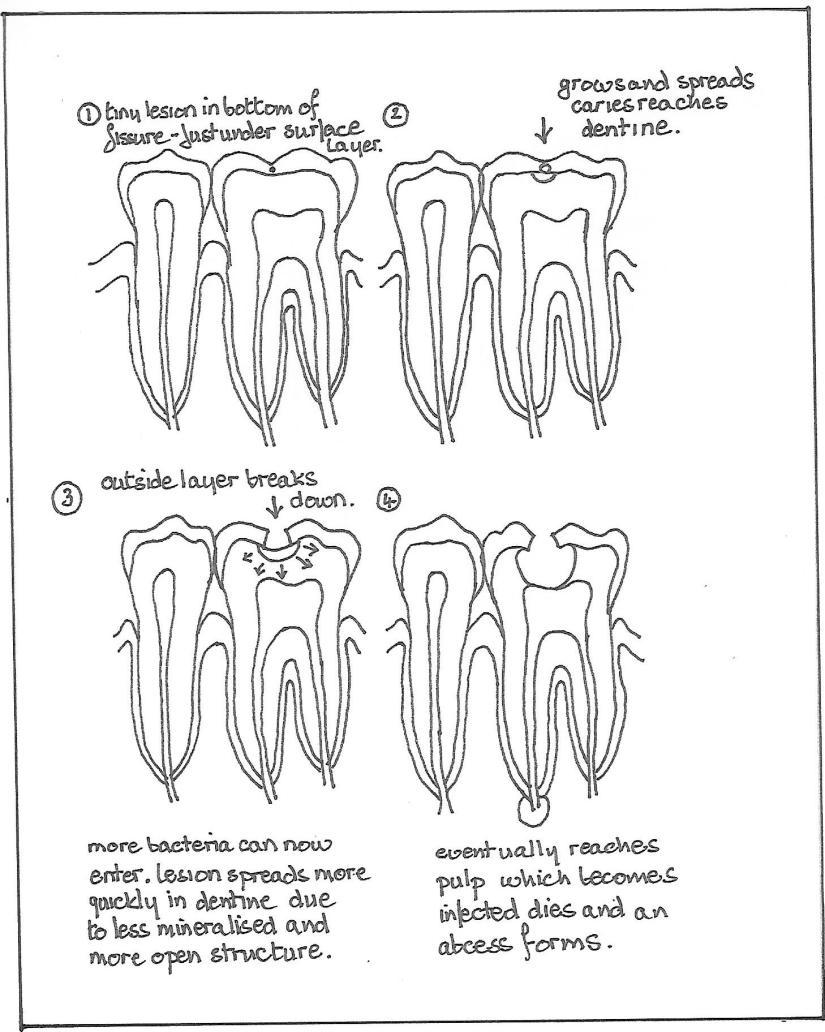
Caries formation on biting surface of tooth- in a fissure.

caries1 pic

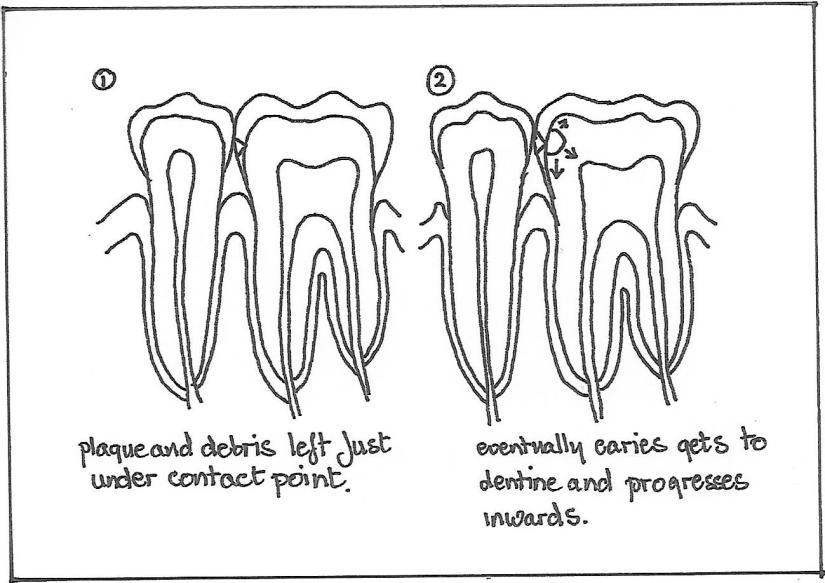
Caries forming between teeth- just under contact point.

Caries2 pic